The answer I finally stopped giving
For most of my life, my reply to the third but why was some version of “because it just is.” This week we published a book of fifty of those questions, answered the way I should have answered them the first time.
My own two are thirty now, and I can still hear the shape of it. Not the first why — the third one. The one that arrives after you have already answered twice, while you are getting the shopping into the car.
What I said, more often than I would like to write down, was some version of “because it just is.” Said kindly. Said while doing something else. And it works, in the narrow sense that it ends the conversation, which is the only thing it does.
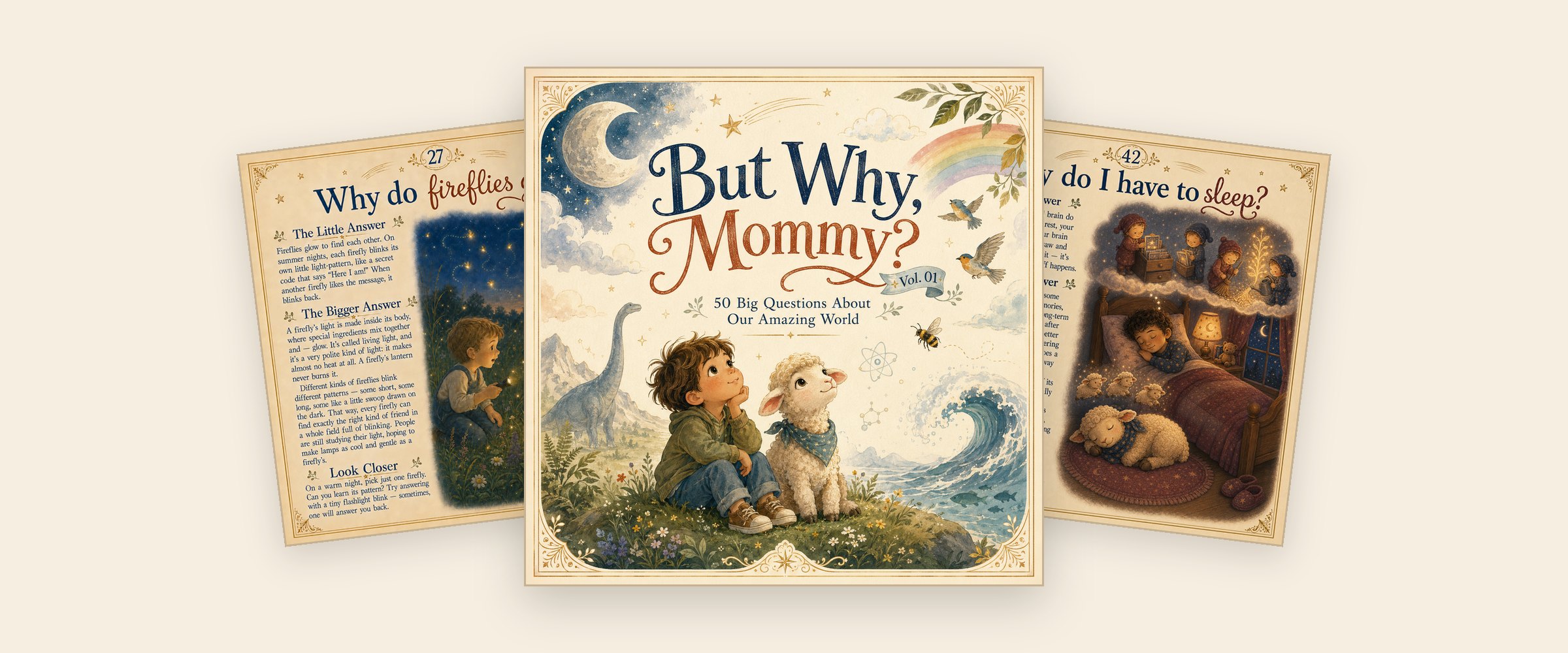
My granddaughter is four and a half, and she has started up again with exactly the same questions, in exactly the same order, and this time I decided to go and find out. That turned into fifty questions, then into a manuscript, and this week into a book with our own name on the spine — But Why, Mommy?, published by Little Lamb Books.
It is not a science book, quite. It is a book about how to answer a small person honestly when you are tired. Five things had to be true on every page.
“Why is the sky blue?”Answer the question they actually asked
A four-year-old asking about the sky does not want a lecture on wavelengths. She wants a real answer, in a sentence, now — and she will decide from that sentence whether you are worth asking again.
So every question in the book opens with what we called the Little Answer. Short enough to say out loud without losing her: sunlight looks white, but it is really made of many colors. When sunlight reaches Earth, the air scatters the blue light in every direction. That scattered blue light is what we see when we look up.
That is the whole first tier. If she runs off satisfied, the page has done its job and you are free to carry on with the shopping.
“Why do I have to sleep?”Then keep going, for whoever is still there
Some children take the short answer and go. Others plant their feet and wait for more, and those are the ones who get fobbed off, because the honest continuation takes longer than you have.
So there is a second tier on every page — the Bigger Answer — written for the child who stayed. It is where the sleep page gets to say the thing that made my granddaughter sit up: your body does most of its growing during deep sleep. You literally get bigger at night, in bed, doing absolutely nothing.
Nobody has to read that part. It is simply there, on the same page, for the night she wants it. That is the difference between a book that answers a child and a book that manages one.
“Is there anyone else in space?”“Nobody knows” is a real answer
This was the one I was most tempted to fudge, and it is now my favourite page in the book. The answer begins with nobody knows yet — not even the smartest people in the world, and it does not walk that back.
Then it does the thing I wish someone had done for me: it explains why the not-knowing is interesting. People are pointing enormous telescopes at faraway worlds and listening for any kind of hello, and so far the universe has been quiet. But “we haven’t found anyone yet” is not the same as “there’s no one there.”
I used to treat not knowing as a failure of the grown-up, something to be covered over quickly. It isn’t. Telling a child exactly where the edge of human knowledge sits is the most respectful thing on the page — and it is the only honest way to hand her a question she is allowed to keep.
“Because it just is” is not an answer. It is a door, closed politely.
“Can plants feel anything?”Say where the edge of the knowing is
Every answer in this book was checked before it was illustrated, and the checking changed things. A handful of lines I was fond of turned out to be the tidy version rather than the true one, and they came out.
The plants page is where you can see the discipline working. Plants have no brains or nerves, so they cannot feel happy or sad or ouch — but they notice a great deal, and some of what researchers are finding is genuinely unsettled. So the page says: trees that may share food through underground fungus webs. We’re still learning how much of this is really going on.
That may cost us a better sentence. It stays. A children’s book is the first place most people meet a fact, and it is a poor place to start them off with something we will have to take back.
“Why do fireflies glow?”End with something you can do tonight
Every question closes with a third small block called Look Closer, and it was the hardest one to write fifty times, because it had to be genuinely doable and cost nothing.
The firefly one is the one we tried first, on a warm evening in the garden: pick just one firefly. Can you learn its pattern? Try answering with a tiny flashlight blink — sometimes, one will answer you back.
Not a craft. Not a printable. Nothing to order. Ten minutes before bed, with a torch you already own — because the point of a book like this is not the book. It is the going outside afterwards.
And a lamb on every page
There is a lamb hiding in all fifty illustrations. It has no name, it is not always the same size, and it is not always doing anything sensible — on the plants page it is whispering to a daisy.
That was deliberate, and not only because a lamb is our whole shopfront. A book you have read is finished. A book with something still to find in it gets opened again on a Tuesday, by a child who already knows why the sky is blue and wants to check on the lamb.
But Why, Mommy? — Volume One
Fifty questions small children actually ask about the world — the sky and the stars, weather, oceans and earthquakes, animals, growing things, and the body they live in. Each one answered in three parts, illustrated on every page.
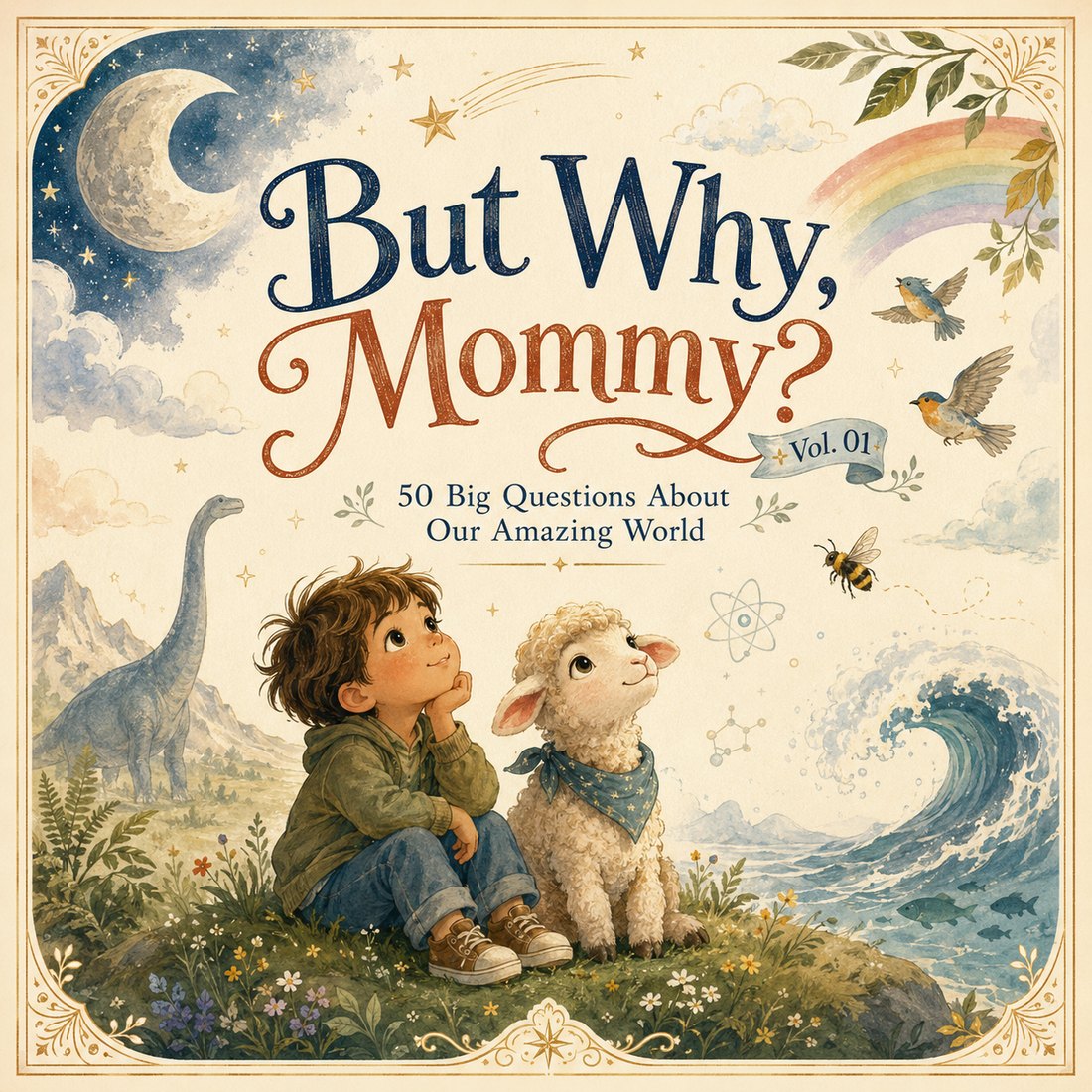
- Inside50 questions, each with a Little Answer, a Bigger Answer, and a Look Closer to try the same night.
- Ages4–8 — read aloud at the younger end, read alone at the older.
- Format8.5″ square paperback, color throughout — and a fixed-layout Kindle edition that keeps the pages exactly as painted.
- Written byRebecca Shepherd, published by Little Lamb Books.
- NextVolume Two — fifty questions about life, people and feelings — is on its way.
We earn a small commission on Amazon purchases. It costs you nothing extra, and it is the only reason this Journal has no sponsors in it.
I am not going to pretend this book stops the third why. Nothing stops the third why, and on the days you have the patience for it you would not want it to.
What it does is give the question somewhere to go. Fifty of them, sitting on a shelf at her height, already looked up — so that on the evening she asks why the sky changes its mind at sunset, the honest answer is already in the house.
Everything for the first day
Our hand-picked back-to-school edit — bags, first-day outfits, labels and keepsakes, plus the independent boutiques that stock them.